The Constitution of the Kingdom of Thailand mandates the formulation of a 20-Year National Strategy to guide long-term national development, aiming to transform Thailand into a high-income, developed country while strengthening institutional and economic capacities. Within this strategic framework, the EEC has been designated as a core development zone under the Thailand 4.0 agenda, advancing competitiveness in strategic manufacturing and service industries through technology, innovation, and targeted investment. The EECO oversees integrated development across Rayong, Chon Buri, and Chachoengsao—encompassing infrastructure, industry, human capital, and livability—thereby enhancing Thailand’s overall competitiveness and supporting sustainable, long-term economic growth.
EEC’s Strategic Industries
The EEC prioritizes five strategic target industries that act as new economic engines to upgrade Thailand’s industrial structure. These clusters accelerate innovation, promote advanced technologies, and strengthen value chains, reducing dependence on traditional manufacturing. Their development also attracts high-quality foreign investment, enhances workforce skills, and expands employment opportunities. Collectively, these industries form a strong foundation for stable, resilient, and sustainable economic growth.
Free Trade Agreements: 17 FTAs with 24 partner countries
Thailand is part of the Regional Comprehensive Economic Partnership (RCEP), which:
Accounts for 31.6% of global GDP
Covers a population of 2.3 billion
Thailand is also part of the Indo-Pacific Economic Framework for Prosperity (IPEF), which:
Accounts for 34.9% of global GDP
Covers a population of 2.6 billion
Growth Potential of the Three Provinces
Economic Outlook of the EEC
The EEC is expected to grow at a slightly slower pace, with economic expansion projected at approximately 2.6 percent in 2025, down marginally from about 2.7 percent in 2024. This moderation is attributable to the global economic slowdown and the impact of the reciprocal tariff measures imposed by the United States, which have resulted in a decline in tourist arrivals, slower investment decisions in the production of goods and services, and reduced inflows of foreign capital. Private consumption has also weakened due to heightened economic uncertainty and persistently high household debt, both of which have curtailed purchasing power among the population.
Chachoengsao
Area: 5,351 square kilometers
Population: 730,543
GDP: 490,005 million Baht GDP per capita: 670,741 Baht Share of Thailand’s GDP: 1.1%
Chon Buri
Area: 4,363 square kilometers
Population: 1,642,016
GDP: 1,188,192 million Baht GDP per capita: 592,335 Baht Share of Thailand’s GDP: 6.2%
Rayong
Area: 3,552 square kilometers
Population: 782,171
GDP: 1,050,952 million Baht GDP per capita: 942,205 Baht Share of Thailand’s GDP: 5.9%
Readiness of the Investment Ecosystem
Land
A Strategic Location
Connected to Global Markets
The EEC is situated in Thailand’s Eastern Region, covering the three key provinces of Chachoengsao, Chon Buri, and Rayong. Its strategic position provides seamless connectivity to international airports, deep-sea ports, and major regional logistics corridors, establishing the EEC as one of Asia’s most important gateways for trade and investment. More than 46 designated special economic promotion zones under the EECO are located within the area.
Quality Workforce and Continuous
Human Capital Development
The EEC places strong emphasis on upskilling and reskilling its workforce through sustained collaboration with educational institutions, universities, and industry partners. These initiatives ensure that local talent meets the needs of advanced and technology-driven industries.
Modern Infrastructure
to Support Future Industries
The EEC has undertaken systematic, large-scale infrastructure planning and investment to build a strong foundation for next-generation industries. Key developments include:
High-speed Rail Linking Three Airports (Don Mueang–Suvarnabhumi–U-Tapao), developed to enhance travel efficiency and improving logistics connectivity.
Laem Chabang Port and Map Ta Phut Industrial Port, infrastructure developed to strengthen maritime transport capacity and accelerate efficient international trade connectivity.
U-Tapao International Airport, being developed as a regional aviation and logistics hub to support passenger travel and cargo transport.
Domestic transportation and logistics connectivity, featuring modern expressways such as the Motorway Network and Burapha Withi Expressway, which provide rapid access between Bangkok, nearby economic zones, and the EEC.
Comprehensive Utilities Infrastructure, including reliable electricity, water supply systems, and advanced telecommunications. Notably, the EEC’s Cable Landing Station serves as a major landing point for international submarine cables, positioning the area as a future digital hub of the region.
This extensive and modern infrastructure network makes the EEC fully ready to support investment in future industries and foster Thailand’s long-term sustainable economic growth.
Regulatory Readiness Under Sections 37 and 43 of the Eastern Special Development Zone Act
The EECO is empowered to grant approvals and permits under 14 laws, enabling investors to commence operations efficiently, accurately, and without delay. The EECO also provides a comprehensive One Stop Service, streamlining regulatory procedures, reducing the need to coordinate with multiple agencies, and significantly enhancing service efficiency for investors.
Stay informed about the latest developments in cooperation between the EECO, international investors, and foreign agencies.
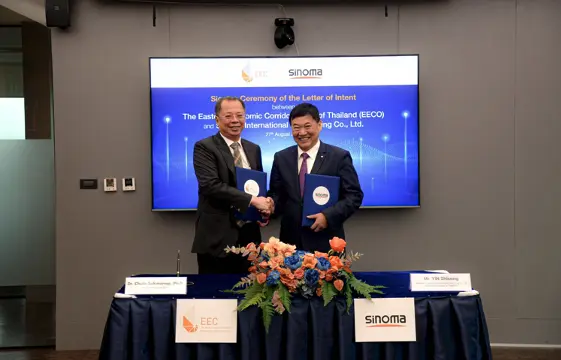
EECO signed an LOI with Sinoma, a leading private-sector company from China, to jointly develop Special Economic Promotion Zones (SEPZ) within the EEC.
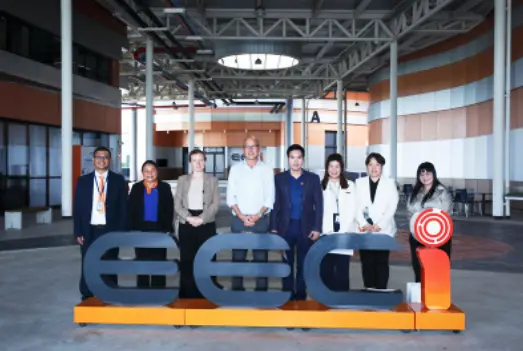
EECO welcomed the British Ambassador on a visit to the EEC area to strengthen investor confidence and promote inward investment from the United Kingdom.
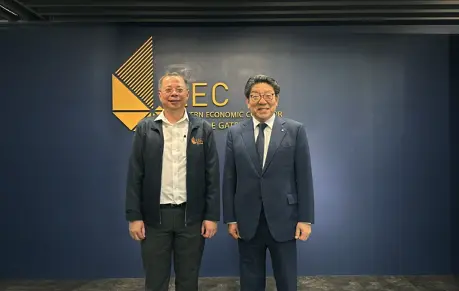
EECO held discussions with JETRO and the Japanese Chamber of Commerce, Bangkok, to advance Thai–Japanese economic cooperation.
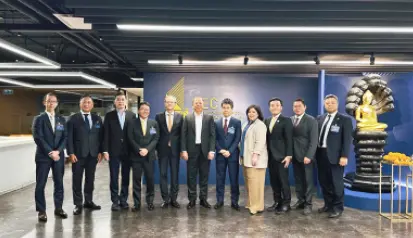
EECO met with Herald Media Group to explore opportunities for strengthening investment cooperation between Thailand and the Republic of Korea.